



IBS AMERICAS | AI SUMMIT SESSIONS | CASE STUDY
Artificial Intelligence in a Large-Scale Operation
With more than 310 stores across 24 states and the Federal District, approximately 90,000 employees, and around 40 million customers served monthly, Assaí Atacadista faces operational challenges that make artificial intelligence an especially relevant tool for its business strategy.
In 2025, the company recorded revenue of R$ 84.7 billion, a scale that highlights the complexity of its operations and the potential gains offered by intelligent automation, data analytics, and improved decision-making processes.
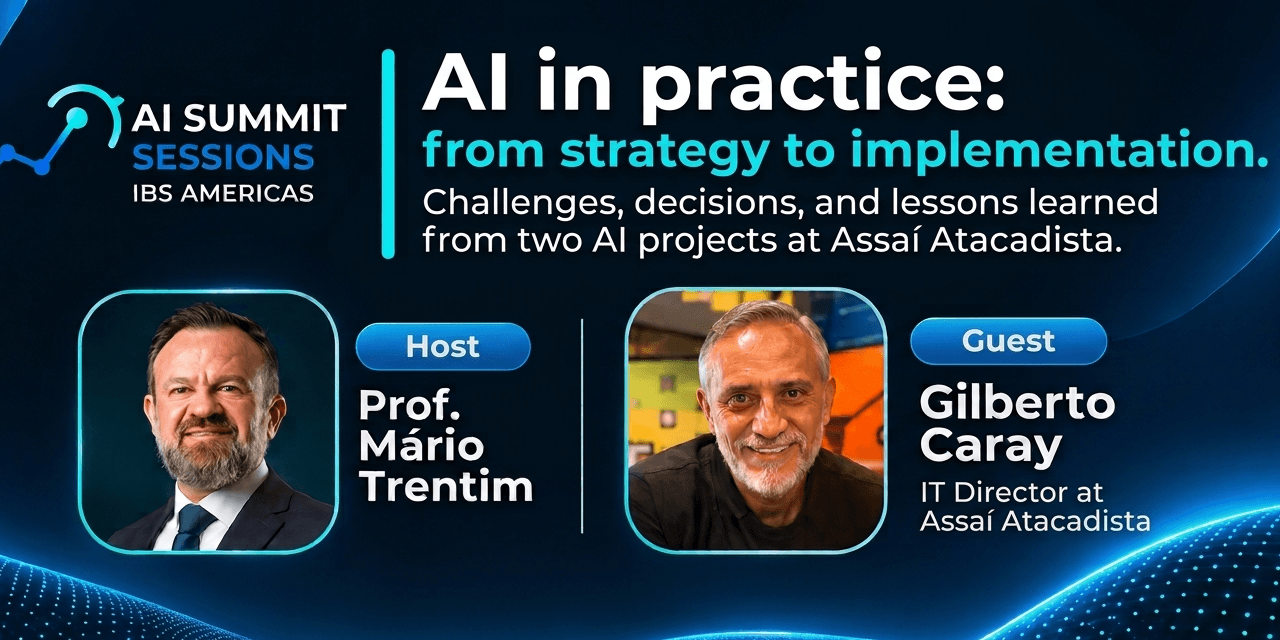
The company’s experience was presented by Gilberto Caray, Chief Information Officer at Assaí, during an edition of AI Summit Sessions, an initiative by IBS Americas, sponsored by Praxian AI, dedicated to discussing real-world applications of artificial intelligence in organizations.
The session explored how the company has been structuring its technological transformation, highlighting two projects: Maia, focused on employee service and support, and Hera, aimed at commercial intelligence and support for pricing and inventory management.
More than just implementing new technologies, Assaí’s strategy seeks to identify situations where AI can effectively improve results, expand management capacity, and create new possibilities for the business.
Maia: Artificial Intelligence at the Service of Employees
One of the main examples of this strategy is Maia, an artificial intelligence agent developed to make it easier for employees to access internal information and services.
In an organization with tens of thousands of professionals distributed geographically, addressing everyday requests represents a significant challenge. Questions about procedures, internal policies, administrative routines, and corporate services can take up support teams’ time and make quick access to information more difficult.
Maia seeks to transform this experience by offering a conversational interface that allows employees to get guidance and access services more simply and quickly.
Its strategic value goes beyond reducing the volume of human support requests. By centralizing access to organizational knowledge, the solution can help standardize procedures, share best practices, and identify recurring challenges faced by professionals.
At a more advanced stage, agents of this kind will be able to adopt increasingly proactive behaviors, identifying request patterns, anticipating needs, and recommending improvements to internal processes.
This evolution represents an important shift: artificial intelligence moves beyond being just a reference tool to also become a mechanism for organizational learning and improvement.
Hera: Artificial Intelligence for Commercial Decisions
The second highlighted project is Hera, an initiative in development to support decisions related to dynamic pricing management and stockout prevention.
In an operation managing more than two million SKUs, commercial decision-making is highly complex. Pricing, margins, demand, product availability, and supply conditions need to be evaluated in an integrated way.
Artificial intelligence offers the ability to analyze a much larger set of variables, uncover less obvious relationships, and support decisions with greater speed and consistency.
Hera represents this approach by seeking to expand managers’ analytical capacity and provide stronger data-backed support for commercial decisions. Its potential is especially relevant in situations where different goals must be balanced, such as protecting margins, maintaining price competitiveness, and ensuring product availability.
As systems of this nature evolve, they will be able to enable earlier identification of risks and opportunities, offering intervention recommendations before issues materialize. Adopting these capabilities, however, requires proper governance, validation, and human oversight, especially when recommendations can have significant financial or commercial impacts.
Governance, Culture, and Organizational Transformation
Assaí’s experience shows that adopting artificial intelligence does not depend solely on the quality of technological models. Its success is also tied to the ability to integrate innovation, organizational processes, data infrastructure, and governance.
One challenge is balancing operational continuity with experimenting with new solutions. In a large company, existing systems must run with high levels of reliability while new technologies are developed, tested, and rolled out gradually. This combination requires an organizational culture capable of balancing operational stability and innovation.
Another key aspect is the governance of AI solutions. As agents begin influencing decisions, it becomes necessary to establish criteria for security, information quality, traceability, and accountability for recommended or executed actions.
Human oversight remains especially important in high-impact decisions. The most promising approach is not simply replacing managers with algorithms, but expanding human capacity to understand complex situations, evaluate alternatives, and act more effectively.
The Next Frontier: Artificial Intelligence as a Service to Customers
While current applications are focused primarily on internal management and operational support, a particularly interesting perspective is incorporating artificial intelligence into the services Assaí itself offers to its customers.
The company serves both end consumers and small business owners, restaurants, and other entrepreneurs who rely on efficient purchasing and restocking decisions. In this context, AI agents could help customers build shopping lists, plan quantities, identify alternative products, and organize orders based on specific needs and budgets.
For business customers, the possibilities are even broader. A small restaurant, for example, could use an intelligent assistant to estimate restocking needs based on its menu, expected foot traffic, and consumption history. Small retailers could receive support to plan purchases, reduce waste, and improve inventory control.
These applications, still presented as future possibilities, would allow Assaí to evolve from a product supplier into a technology partner for its customers, adding intelligence and management capability to its value proposition. This represents a competitive differentiation opportunity that goes beyond internal productivity gains and brings artificial intelligence closer to the shopping experience itself.
From Automation to Organizational Intelligence
The Maia and Hera projects illustrate two complementary dimensions of the transformation driven by artificial intelligence.
The first focuses on interacting with people, sharing knowledge, and simplifying access to services. The second explores the ability to process and analyze information to support complex commercial decisions. Both point toward a broader evolution: moving from systems that simply respond to requests to agents capable of identifying relevant situations, anticipating problems, and proposing actions.
This transition, however, must be accompanied by clear value-creation criteria, risk controls, and mechanisms to evaluate results.
Assaí’s experience demonstrates that the transformative potential of artificial intelligence does not lie simply in the number of applications developed, but in the ability to embed them into the processes and decisions that truly drive business performance. For organizations across different sectors, the main takeaway is that AI transformation should start by understanding business challenges, rather than picking a technology in advance.
About AI Summit Sessions
AI Summit Sessions is an initiative by IBS Americas, sponsored by Praxian AI, that brings together executives, specialists, and business leaders to discuss real-world experiences applying artificial intelligence in organizations.
Through interviews and discussions conducted with the support of its Executive Committee, the program seeks to share insights, challenges, results, and perspectives on the evolution of AI in the business environment.
The session dedicated to Assaí featured Gilberto Caray, the company’s CIO, and was hosted by Mário Trentim.
Explore the Initiatives:
-
IBS Americas: ibs-americas.com
-
Praxian AI: an initiative specialized in diagnosing opportunities and developing enterprise artificial intelligence solutions