



Studying in California means experiencing a region known for its combination of universities, innovation, cultural diversity, and business environments connected to global trends. The state brings together different economic and academic ecosystems.
Technology, entertainment, communication, design, sustainability, entrepreneurship, and research are among the fields that help build its international influence.
For international students, this experience goes beyond the classroom. Living in another country calls for communicating in English, independence, cultural adaptation, and openness to different ways of learning and collaborating.
These qualities make California a relevant destination both for those seeking a full academic degree and for professionals interested in short-term international programs.
Before choosing a program, however, it’s important to understand how the experience works and to assess how it can contribute to the participant’s academic and professional goals.
Why California attracts international students
California has renowned universities, a multicultural population, and an economy connected to a range of sectors with international reach.
Regions like Silicon Valley are associated with the development of technology and entrepreneurship. Los Angeles has a strong presence of companies tied to entertainment, communication, design, and the creative economy. San Diego also stands out in areas such as research, health, and innovation.
This diversity allows students to find different professional reference points within the same state.
The international environment is another important factor. Living alongside people of different nationalities broadens exposure to languages, cultural perspectives, and ways of interpreting problems.
The combination of academic training, cultural experience, and proximity to business ecosystems helps explain why studying in California is part of the plans of so many students and professionals.
What the academic experience in California is like
The experience varies depending on the university, the program, and the level of study. Even so, many programs value participation, the exchange of ideas, and the practical application of content.
Case studies, group work, presentations, and discussions can be part of the routine. Rather than simply following a lecture, participants are encouraged to ask questions, defend arguments, and collaborate on building solutions.
This dynamic may require adaptation from students used to other teaching models. Preparing for class, taking part in activities, and communicating questions clearly help you get more out of the experience.
In programs focused on business and professional development, the content is usually connected to organizational challenges. Leadership, innovation, strategy, communication, technology, and management are among the topics that may be explored.
Exchanging ideas with professors and peers also makes it possible to compare market experiences and observe how different contexts influence professional decisions.
How California connects to innovation and business
California is associated with companies and movements that have shaped sectors such as technology, entertainment, mobility, communication, and the digital economy.
This environment doesn’t automatically turn every program into an innovation experience. Even so, studying in the state lets you observe up close a professional culture marked by experimentation, entrepreneurship, and the search for new solutions.
In the classroom, this context can appear in case studies, market examples, and discussions about technological change.
Outside the university, events, professional communities, and academic activities can broaden your contact with emerging topics. Depending on the program, there may also be talks, visits, or projects connected to the local ecosystem.
For professionals, this exposure helps them understand how ideas are tested, communicated, and turned into business models.
How cultural diversity shapes the experience
California brings together people with different backgrounds, languages, and life paths. This diversity is present in its cities, on its campuses, and in professional relationships.
For international students, a multicultural setting creates opportunities to learn beyond the formal content. Working in groups with people from other countries requires listening, flexibility, and the ability to adapt how you communicate.
Differences can appear in how people take part in a discussion, organize tasks, give feedback, or make decisions.
Learning to navigate these variations develops skills that matter for global companies. Intercultural communication, empathy, and adaptability are increasingly relevant on distributed teams and international projects.
The experience also lets students see their own culture from a new perspective, recognizing habits that once seemed natural or universal.
How you’ll use English during the experience
In a course taught in English, the language is used to follow classes, read materials, take part in activities, and present work.
Outside the university, it shows up in everyday situations such as transportation, meals, shopping, and social life.
This combination creates an immersion that can build confidence and speed in communication. English stops being just an exercise and becomes a tool to solve problems, learn, and build relationships.
You don’t need to understand every word to make the most of the experience. Strategies such as reviewing materials, noting key terms, and asking for clarification help you keep up with activities.
The ideal is to arrive at a level suited to the program and keep an active attitude. The more participants engage in conversations and activities, the greater their exposure to the language tends to be.
How networking works during an international program
Networking can happen in the classroom, during academic activities, at events, or in informal conversations on campus.
Fellow students already represent a relevant network. They may work in different sectors, have varied professional backgrounds, and offer perspectives on other markets.
Professors can also become academic and professional references. Taking part in discussions, asking thoughtful questions, and showing genuine interest help create more meaningful interactions.
The goal shouldn’t be simply to collect contacts. Professional relationships gain value when there is exchange, continuity, and genuine interest.
After the program, staying in touch, sharing what you’ve learned, and following your peers’ projects help preserve the network built during the experience.
What formats are available to study in California
International students can find everything from short-term courses to bachelor’s, specialization, master’s, and doctoral programs.
Full degrees require longer planning, a larger investment, and specific academic processes. In general, they also involve proof of proficiency, academic documentation, and an extended stay in the United States.
Short-term international programs are an alternative for those who want to experience the American university environment without stepping away from their career or studies in their home country for years.
These courses can last a few weeks and concentrate content in specific professional areas. The intensive format makes it possible to combine classes, academic activities, language exposure, and cultural experience.
For professionals and executives, this format may fit better into a work routine and serve as a first step before a longer program.
What it’s like to study in Los Angeles
Los Angeles is a vast, multicultural city connected to a range of economic activities. Beyond entertainment, the region is home to companies and initiatives related to technology, communication, design, commerce, education, and social innovation.
For international students, this variety broadens their professional and cultural repertoire. The city brings together communities from different parts of the world, which can make the experience especially rich in exposure to languages, cuisine, and ways of life.
At the same time, the size of the region calls for organization. Distances, transportation, the location of your accommodation, and commute times should all be factored into your planning.
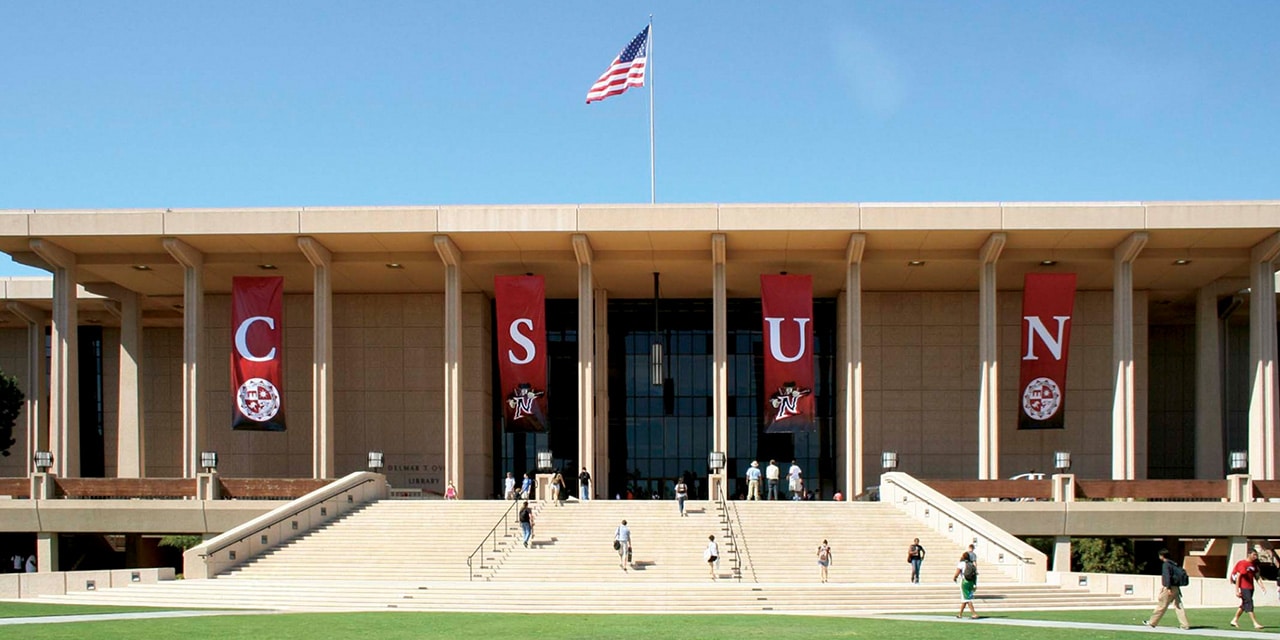
California State University, Northridge (CSUN) is located in Northridge, a district of the city of Los Angeles. The university welcomes international students and offers academic programs across different fields of knowledge.
How much it costs to study in California
Costs depend on the type of program, its length, the university, the city, and the student’s lifestyle. Your budget should account for the program fee, enrollment, airfare, accommodation, meals, transportation, travel insurance, documentation, and personal expenses.
Location has a big influence on the budget. Accommodation near campus can reduce commuting, while options farther away need to be weighed against cost and travel time.
It’s also important to keep an eye on the exchange rate and set aside a reserve for unexpected expenses.
For short-term programs, the investment tends to be lower than what a full degree or graduate program abroad requires. Partial scholarships, when available, can reduce part of the academic cost, but the participant remains responsible for the other expenses.
Researching in advance makes it possible to compare options and build a more realistic financial plan.
How to prepare to study in California
The first step is to define the goal of the experience. Developing leadership, improving your English, studying innovation, and building a network are different goals, though they can all be present in the same program.
Next, you need to choose a program aligned with your current academic or professional stage. Content, length, English level, and practical application should all be considered.
Document preparation includes checking your passport, entry rules, forms, insurance, and the program’s other requirements. Because these requirements can vary, students should consult the official guidance that applies to their trip.
It’s also advisable to research the university, the region, and the academic routine. Understanding what classes will be like and which activities call for more participation reduces the initial uncertainty.
Before the trip, reviewing vocabulary related to the program, preparing a professional introduction in English, and setting networking goals can also improve the experience.
How to turn the experience into professional development
The value of an international experience isn’t only in the certificate or the trip. It depends on how the participant uses what they learn after the program.
During the course, recording ideas, examples, and contacts helps organize your knowledge. Back home, professionals can share what they learned with their team, apply a tool in a project, or propose a new approach to a challenge.
It’s also important to know how to explain the experience concretely. Rather than simply mentioning that they studied in California, participants can present which skills they developed, which projects they carried out, and how the content contributed to their goals.
This connection between learning and practice turns international education into a consistent part of a professional’s path.
How to study in California with IBS Americas
IBS Americas offers short-term international programs in partnership with California State University, Northridge, in Los Angeles.
The programs cover areas such as business, leadership, innovation, artificial intelligence, communication, design thinking, and project management. Classes are taught in English and allow students and professionals to experience the academic environment of an American university.
During the experience, participants can broaden their knowledge, practice the language, build a network, and observe different perspectives on career and business.
Selected candidates may also compete for partial scholarships, according to the criteria and conditions of the current process.
With planning and a choice aligned with your professional goals, studying in California can become an important step toward developing a global perspective and preparing your career for new contexts.